The Mysterious Little Girl Who Changed Our Lives Forever..

A Little Girl Gave Me a Butterfly Hair Clip at My Son’s Birthday—Five Weeks Later, I Learned Why
A fictional story about a birthday party, a small gift, and an unexpected friendship.
The Girl Beside the Picnic Table
At my son’s ninth birthday party, I spent most of the afternoon moving between unfinished tasks.
Someone needed a drink. Someone else could not find a jacket. The candles had disappeared beneath a pile of paper plates.
We had gathered under a pavilion in the park, with balloons tied to the posts and a cake waiting in its box.
My son was having a wonderful time.
That was what mattered.
Then I noticed a little girl standing beside an empty picnic table.
She was a few steps away from the other children, watching them play.
I assumed she was one of my son’s classmates.
But while the others ran toward the next game, she stayed where she was.
Her hands were clasped tightly in front of her.
And she was crying.
“You Don’t Have to Stand Here Alone”
I approached slowly.
“Hi. Are you all right?”
She wiped her face with her sleeve.
“I’m sorry.”
“You haven’t done anything.”
She looked toward the gift table.
“I didn’t bring anything.”
I glanced at the brightly wrapped boxes, then back at her.
“That’s okay.”
Her expression suggested she did not believe me.
I sat at the end of the picnic bench, leaving room beside me without asking her to move.
“What’s your name?”
“Mia.”
“Would you like some water, Mia?”
She nodded.
When I returned with a cup, she was still standing in the same place.
I put it on the table.
“You don’t need a present to have a piece of cake.”
That earned the smallest smile.
The Butterfly Clip
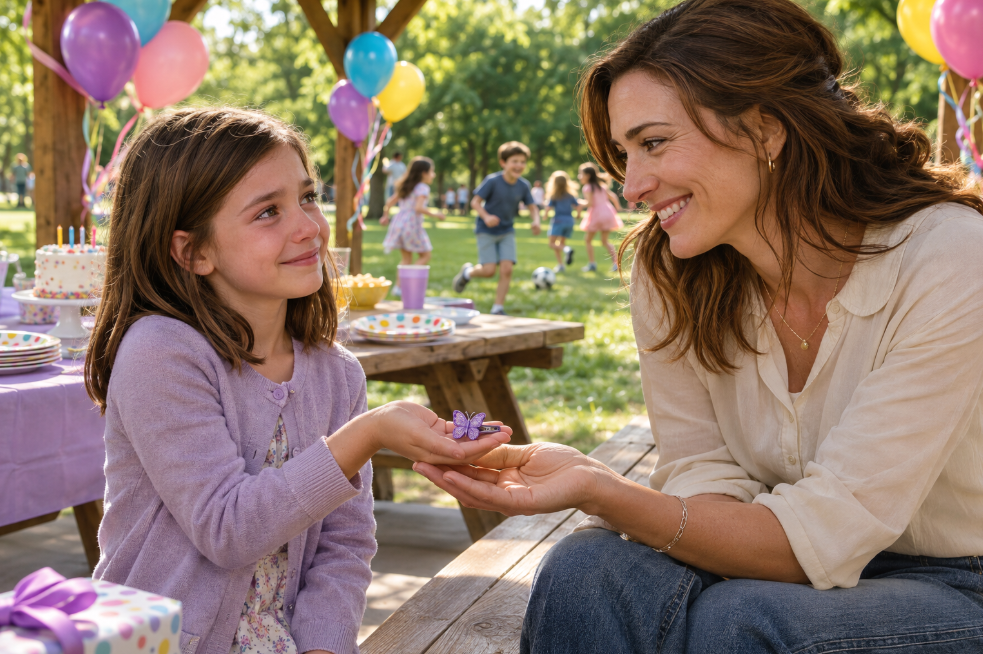
Mia reached into her pocket.
For a moment, she seemed undecided.
Then she opened her hand.
A little butterfly hair clip rested in her palm.
It had purple wings and a few tiny decorative stones. One wing was slightly scratched.
“You can have this,” she said.
I looked at her carefully.
“You don’t have to give me anything.”
“I want to.”
“Are you sure?”
She nodded.
I accepted it.
“It’s lovely.”
She watched as I clipped it into my hair.
Then she smiled properly for the first time.
My son ran over a moment later to ask whether the cake was ready.
I introduced them.
“This is Mia.”
“Do you want to play?” he asked her.
She looked at me.
“You can if you’d like,” I said.
She left her cup on the table and followed him.
A Place in the Game
The children were in the middle of a complicated game whose rules seemed to change whenever someone was about to lose.
My son explained it badly.
Another child corrected him.
Mia listened with complete seriousness.
Soon, she was running with the others.
I watched for a moment before returning to the cake.
When we gathered to sing, Mia stood near the end of the table.
She knew the song.
She sang quietly.
Afterward, she accepted a slice and thanked me as though I had done something remarkable.
I asked whether an adult was meeting her.
“My grandma’s nearby,” she said.
With children arriving for second helpings and a parent asking about a missing bag, the conversation was interrupted.
When I looked for Mia again later, she had gone.
The Question the Next Morning
The butterfly clip was still in my hair when we returned home.
I removed it that evening and placed it beside my keys.
The next morning, while my son opened a box from one of his games, I asked about her.
“Mia seemed nice.”
“Who?”
“The girl you played with yesterday.”
“Oh. Yes.”
“Is she in your class?”
“No.”
I paused.
“Another class?”
“I don’t think so. I met her yesterday.”
At first, I assumed she had come with another child.
I asked a few parents whether she belonged to their group.
None of them knew her.
I did not have a surname.
Only Mia.
And a butterfly clip that suddenly seemed like part of a conversation I had not understood.
The Clip Beside My Keys
For several days, I thought about her.
I remembered how closely she had watched the gift table.
How she asked for nothing.
How relieved she looked when my son invited her to play.
I wondered whether I should have asked more questions before allowing myself to become distracted.
But I also knew how little I had to work with.
We returned to the park occasionally.
I looked around without expecting to find her.
The clip stayed in the little bowl beside our front door.
Sometimes I moved it when searching for a key.
Each time, I remembered her opening her hand.
Then ordinary life continued.
School.
Work.
Groceries.
A permission slip signed just before we had to leave.
Five weeks passed.
A Familiar Face in the Park
I saw Mia again on a Saturday afternoon.
My son was using the playground while I walked toward a bench.
She sat at a nearby picnic table, drawing on a folded piece of paper.
I recognized her before she looked up.
“Mia?”
Her pencil stopped.
Then she smiled.
“The butterfly.”
I touched my hair automatically, although I was not wearing it.
“I still have your clip.”
“You do?”
“Of course.”
I asked whether I could sit at the other end of the table.
She nodded.
For a while, we discussed the picture in front of her.
It showed a house, a tree, and several small figures.
Then I asked where her grandmother was.
“At the community room,” she said, pointing toward a building across the path. “She’s finishing something. I’m waiting here.”
I told her I would like to say hello when her grandmother came out.
The Birthday Question
Mia looked toward my son.
“Is he still nine?”
I laughed.
“Yes. For quite a while yet.”
She considered that.
“Did he like his birthday?”
“He loved it.”
“I liked it too.”
“I’m glad.”
She pressed her pencil against the paper without drawing.
Then she said, “I hadn’t been to one like that.”
“Like what?”
“With games. And everyone singing.”
I waited.
She looked embarrassed.
“I wasn’t supposed to be there.”
“You mean you weren’t invited?”
She nodded.
“I heard the children.”
I remembered the pavilion, open on every side.
The music.
The balloons visible from the path.
“I only wanted to look,” she said.
What Mia Told Me
She explained the story in small pieces.
Her parents had both died.
She lived with her grandmother now.
I did not ask her to describe how they died or give me details she had not offered.
She talked instead about the apartment, her grandmother’s cooking, and the things they did together.
On the day of the party, she had been near the park with her grandmother.
She had wandered toward the pavilion after hearing the celebration.
“I thought maybe nobody would notice,” she said.
I looked at her drawing.
There were balloons beside the tree.
“Were you upset because you didn’t have a gift?”
She nodded.
“Everyone else did.”
I remembered her small hand and the scratched purple wing.
“That clip was yours, wasn’t it?”
“Yes.”
“Did you want me to give it to your friend?”
She shook her head.
“It was for you.”
Meeting Her Grandmother
A woman emerged from the community building carrying a cloth bag.
Mia waved.
“Grandma.”
I stood and introduced myself.
The woman’s name was Elaine.
Recognition crossed her face when I mentioned the birthday party.
“Oh,” she said softly. “You’re the lady with the cake.”
Mia looked down at her paper.
Elaine explained that she had found Mia nearby that afternoon and learned afterward about the celebration.
She had worried about the uninvited visit.
“I told her we should have asked.”
I nodded.
“I wish we’d had the chance to meet then.”
We spoke while the children watched my son attempt something ambitious on the climbing frame.
Elaine confirmed what Mia had told me about her parents.
She did not offer a long explanation.
I did not ask for one.
The conversation moved toward school, the neighborhood, and how quickly children seemed to grow.
An Invitation for Both of Them
Before we left, I asked whether they would like to join us for lunch sometime.
Elaine hesitated.
“That’s very kind.”
“I mean both of you.”
She glanced toward Mia.
I gave her my number.
“There’s no need to decide now.”
I wanted the invitation to be something she could accept comfortably, rather than a response she felt required to give in front of her granddaughter.
Later that evening, Elaine called.
We chose the following Sunday.
When I told my son, he asked whether Mia could bring something to draw with.
“I’m sure she can.”
“Good. She draws better trees than I do.”
That was his entire assessment of the situation.
I liked it.
The First Sunday
Mia and Elaine arrived with a small container of biscuits.
“You didn’t need to bring anything,” I began.
Elaine smiled.
“I know. We wanted to.”
I accepted them.
Mia came inside quietly, looking toward the kitchen and then the stairs.
My son showed her where he kept the drawing supplies.
Within minutes, they were arguing politely about whether their picture needed a river.
Elaine helped me carry plates to the table.
At first, our conversation was careful.
Then we discovered that we shared a strong opinion about a television programme and very different opinions about the best way to cook potatoes.
By dessert, nobody seemed to be searching for the right thing to say.
A Routine Nobody Announced
There was no moment when we formally decided that Sundays belonged together.
After the first lunch, we arranged another.
Sometimes we cooked.
Sometimes we shared something simple.
The children drew, played games, and disagreed about what to do next.
Elaine brought recipes, stories, and an ability to notice when I had forgotten something in the oven.
I helped her with things when she wanted help.
She helped me too.
That mattered.
I did not want our friendship reduced to an account of what one household provided and the other received.
We were learning one another’s habits.
Some weeks, one person had more energy.
Other weeks, someone needed to sit down and let another person make the tea.
When Mia Began Asking
At first, Mia accepted whatever activity my son suggested.
Eventually, that changed.
She began saying when she preferred something else.
She asked for another colour of pencil.
She said she did not like a particular game.
Once, she announced that she wanted to sit with the adults for a while.
I took those small statements as invitations to listen.
She did not need to be endlessly agreeable to remain welcome.
When the children argued, we helped them sort it out.
Nobody told my son that Mia must always have her way.
Nobody told Mia that being a guest meant she could never object.
They were becoming friends rather than characters in a story we had written for them.
The Gift I Offered Back
One Sunday, I brought out the butterfly clip.
Mia recognized it immediately.
“I told you I kept it.”
She ran a finger along the scratched wing.
“If you’d like it back, you can have it,” I said.
She thought about that.
Then she shook her head.
“It’s yours.”
“Thank you.”
I put it in my hair.
She studied it.
“It’s a little crooked.”
“Better?”
“No.”
She laughed and showed me which way it should sit.
Elaine watched from the kitchen doorway.
Later, she told me that Mia had spoken about the clip several times after the party.
She had wanted to know whether I might keep it.
“I’m glad I can answer that now,” Elaine said.
What Our Families Found
The friendship did not remove what Mia and Elaine had lost.
It did not make every day easy.
There were conversations that belonged to them and memories they chose when to share.
I learned not to fill every quiet moment with a question.
I also learned how much their presence added to our lives.
My son gained a friend.
I gained someone who could make me laugh while we cleared the table.
Our Sundays became less rushed because there was a reason to stay seated a little longer.
Sometimes I think about the party and how close I came to missing the moment beside the picnic table.
I could easily have assumed another adult was helping the crying child.
I am glad I walked over.
The Little Butterfly
The clip still rests beside my keys when I am not wearing it.
Its wings are no less scratched than they were that afternoon.
It reminds me of Mia’s hesitation before handing it over.
At the time, I thought I was accepting a small gift from a child embarrassed about arriving empty-handed.
Now I remember the rest.
A birthday she wanted to experience.
A grandmother I had not yet met.
An invitation that needed to include them both.
When the doorbell rings on Sunday, my son usually reaches it first.
I hear him greet Mia, then ask what she wants to do.
Behind her, Elaine calls hello.
I put another plate on the table.
The butterfly stays in its bowl until someone needs the keys.